 Bardney · Southrey · Tupholme · Bucknall
A hundred loaves at the Southrey bridge.
By Geoffrey Pacey · · 9 min read
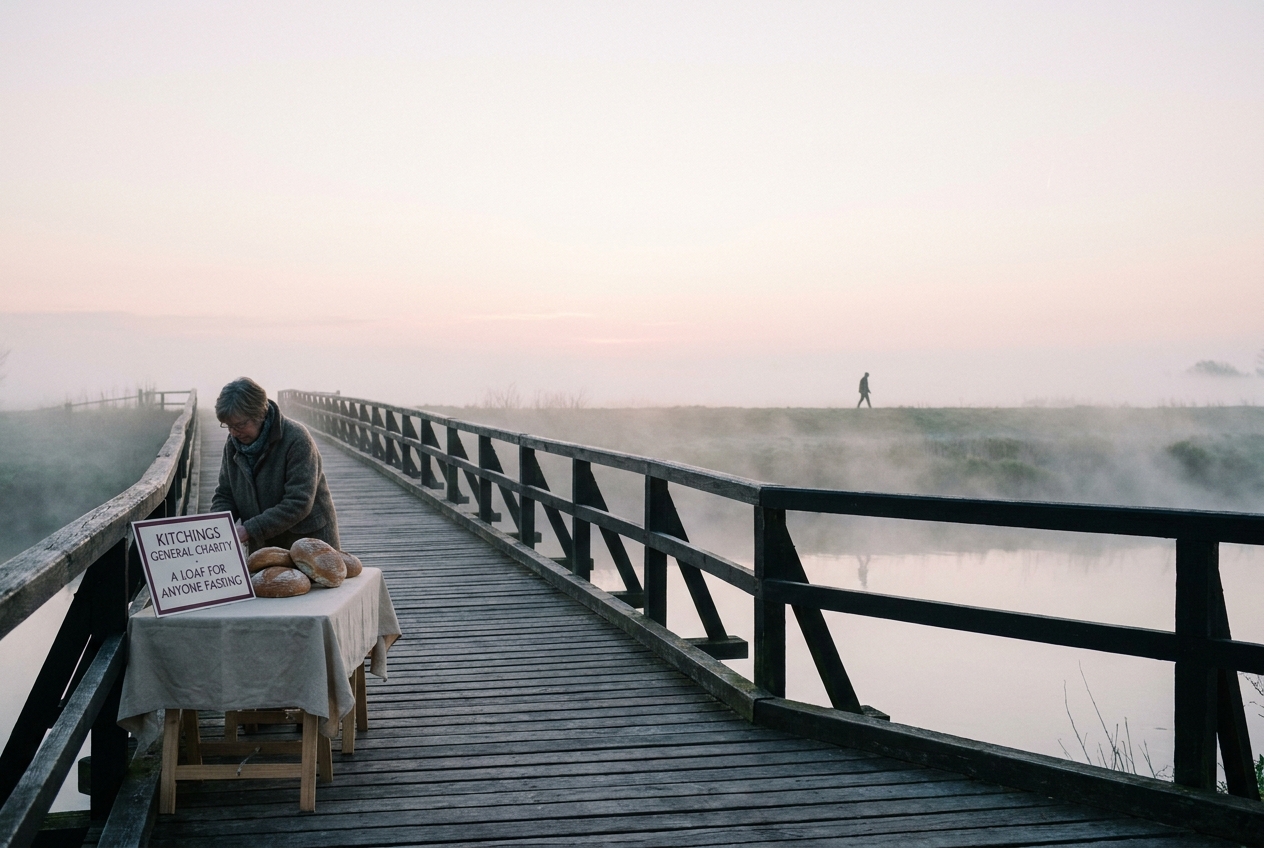
There is a moment, on the spring-fair Saturday in Southrey, when the bridge over the River Witham is fuller than the church on Christmas Eve. It happens at about ten in the morning. The mist is mostly off the water by then. The hedgerow primroses have done the work of opening overnight. People come up from the village with their dogs, in their long coats, and they walk the half-mile from the parish hall to the bridge because that is what one does at the spring fair, and it is what people have done for as long as anyone can remember.
This year we put a hundred loaves on the bridge. We had been talking about it through the winter trustees' meetings — whether the trust might do a little more than usual for the spring fair, given how thinly stretched the village had become in February. Katie suggested the bakery; Darren suggested the count of a hundred; Christopher pointed out, sensibly, that we should make sure the bakery could spare them.
Pip Wallis, who runs the small bakery on the corner by the Wagon & Horses in Bardney, agreed at once. She baked them through the Friday night, in the way bakers do, with the oven on from eleven in the evening to four in the morning. The trustees collected them in two cars at half-past seven on the Saturday and drove them down the lane to Southrey at the speed of an old hatchback full of fresh bread, which is a particular slow speed and a particular smell, and which I do not think any of us will forget.
The bread was laid out on three trestles at the bridge end of the lane, on a long bolt of pale linen Catherine had brought along from the village hall. There was no sign and there was no ribbon. We did not photograph it. The trustees were not in hi-vis. The arrangement was simply: a loaf, free, to anyone walking past who would like one. There was no cap, no register, no condition. We had decided some weeks earlier that the loaves should be entirely without form.
What happened next was much as we had hoped and a little more. A few of the early walkers took two, because they were collecting one for a neighbour. A few took none, because they had a loaf already from their own kitchen. The schoolchildren of Bardney came down from the parish hall in a small noisy parade at nine, and many of them carried a loaf away under each arm like Roman senators. By ten there were perhaps thirty loaves left. By 10.30 the trestles were empty save for a few crumbs and the linen.
We had baked, between us — Pip's bakery, the parish, the trust — one hundred and four loaves, in fact. Pip had over-counted on purpose. The remaining four went, in the afternoon, to four households on the Southrey pensions list, posted with the May letter so that they would arrive together. One of those households, I am told by Katie, had a granddaughter staying that week who was very pleased. The other three said that they had not seen a loaf shaped quite like that since their own mothers had baked.
Why a loaf, on a bridge.
It is fair to ask why a charity that exists to make hardship grants should be in the bread business at all, even for a Saturday morning. The short answer is that we are not, not really; the loaves came from Pip and were a gift. The longer answer is that part of what a small parish charity can do is to put itself in the same place as the people it serves, on a fine spring morning, without anyone having to ask for anything, and let the day take its shape.
The trustees have argued about this kind of thing before. It is the same argument that has run through the trust for fifty years, since the first Witham Walk in 1972. Do we keep our heads down and write quiet cheques to a small list of named households, or do we put ourselves in the village in some visible way that risks looking like a fundraising ploy? Most years, we keep our heads down. This year we put a hundred loaves on a bridge. Both, I think, can be right, in their season.
It was Reg Allcroft, the chair before me, who once said that a small charity is rich when it is welcome at a kitchen table. I have thought of that line all this week. There is nothing especially original about giving out free bread on a Saturday morning. But the bread was made by a person in our village whom most of the village knows; it was laid out on a piece of linen from the parish hall; it was carried home by the children of households who, in some quiet number, have been written to by the trustees in the harder months. It was, in that sense, an entirely local loaf, all the way through.
A small note on the figures.
So that this is not entirely a sentimental letter, the figures. The bread cost the trust £74.40 in materials, which Pip charged us at cost. The trustees' own time was given freely, as is always the case. We collected £62 in voluntary donations from walkers on the bridge, which we had not asked for and which arrived in the linen tablecloth in coins and folded notes by the end of the morning. The trustees agreed that this £62 should be added to the Quiet Door fund, where it now sits, awaiting the next case to come through that door.
The spring fair, in its small entirety, raised £318 for the Kitchings General Charity. We are most grateful to Pip Wallis, to the parish council at Southrey, to the dog-walkers of the four parishes, and to the bridge itself, for holding still for an hour or two on a fine morning.
Filed under: spring fair, Southrey, Quiet Door, the bakery.
Next quarterly letter: 8 July 2026.