 Bardney · Southrey · Tupholme · Bucknall
To make a small difference, very locally, without any fuss.
We do one thing: we put small amounts of money into the hands of households in difficulty in the parishes of Bardney, Southrey, Tupholme, and Bucknall. We do not aspire to scale.
Our purpose, in one paragraph.
The Kitchings General Charity exists to relieve modest hardship in four parishes of the Witham valley in Lincolnshire. We exist for the Southrey widows first — that was the order of priority the Misses Kitching set down in 1864 and which we have honoured without interruption. We exist for the schoolchildren of Bardney and Bucknall second. And we exist for any household in the four parishes, third, that finds itself in difficulty and approaches us for help. We have no other purpose.
We are small. Our income is around thirty-two thousand pounds a year and our grants are typically between £40 and £400. We do not, and cannot, fix structural poverty. We do not run services. We do not advocate. We have no paid staff and no premises other than a vestry room. We are a very modest line of credit at the edge of village life, and we try to be as quiet and as quick as a small charity can be.
How a £150 grant in February becomes a quiet kept household in May.
We do not pretend the chain is more complicated than it is. Three small steps, four parishes, one trustee meeting a quarter.
A household applies.
A single page of A4 — sometimes by post, sometimes by email, occasionally over the telephone to one of the trustees — explaining what has gone wrong and what would help.
Nine trustees decide.
The trustees meet four times a year, with a Quiet Door reserve for urgent cases between meetings. A modest grant is awarded, usually within ten days of the application being received.
A specific need is met.
A heating bill is paid, a school uniform is bought, a fortnight of groceries is covered. The household is kept on its feet through a difficult month. That is, almost always, the end of the matter.
Six small commitments we try to live by.
Plain envelopes.
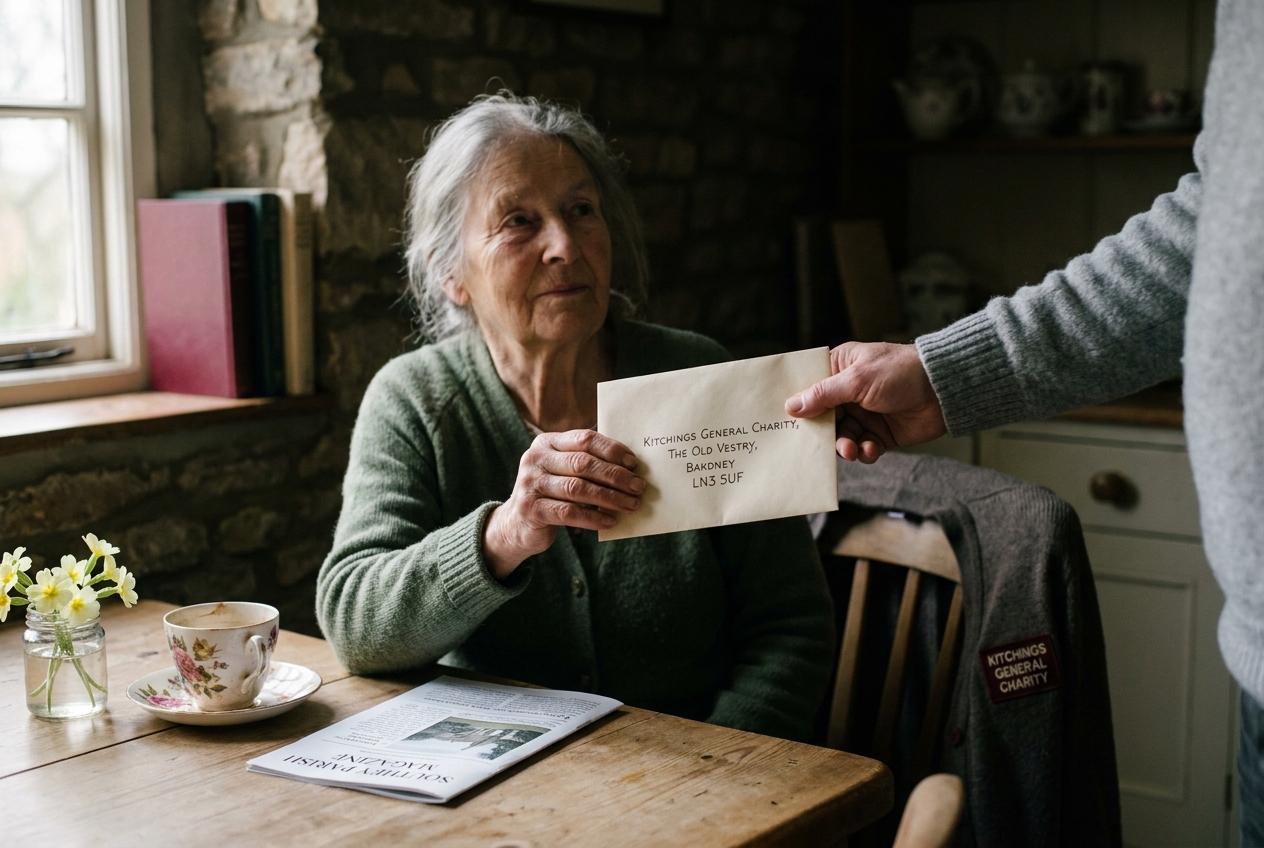
Grants arrive in hand-addressed envelopes, not with the charity's name printed on the outside. Hardship is private; we honour that.
No application forms.
We have never used an application form. A single side of A4, written in your own words, is enough. The trustees will read it.
A reply within a week.
We aim to reply to every enquiry within five working days, and to every formal application within ten. We meet this target most of the time.
A personal letter, even in a refusal.
If we cannot help, we say so personally and we say why. We do not use a template. We do not write 'unsuccessful'.
Stay in the four parishes.
Our area of benefit is fixed by the scheme of management. We have politely turned down well-meaning offers that would have taken us beyond it.
Small & punctual.
The Southrey pensions have not been late in sixty years. We consider that, more than the cheque amount, the thing that matters most.
What we have tried and not yet been able to do.
Between 2018 and 2020 the trustees attempted to set up a small fuel-poverty pilot in partnership with the Lincolnshire Community Foundation: a scheme to underwrite top-ups for households on prepayment meters in the four parishes during the coldest fortnight of each winter. We raised £4,200 for the pilot, made the necessary safeguarding arrangements, and identified seventeen eligible households across the area.
The pilot did not work as we had hoped. The administrative cost of operating the top-up scheme — mostly the time of one of our trustees in liaising with the prepayment meter operator — consumed roughly forty per cent of the pilot budget. The trustees concluded, in spring 2020, that we were not equipped to run a continuing operation of that kind, and that the same money would do more good if it were given out as small unrestricted hardship grants. We wound the pilot up, returned the residual funds to the Community Foundation with thanks, and have stayed with our older, simpler practice since.
It is a small failure, and one we mention because it taught us where the edge of our competence is. We are good at receiving a request and writing a cheque. We are not, on present evidence, good at running a service. We do not intend to attempt it again unless the trustees of a future generation see something we cannot.
Read our funds in detail.
Four small, named funds. One for the widows, one for hardship, one for the schools, one for emergencies.