 Bardney · Southrey · Tupholme · Bucknall
A Bardney classroom where the rain came in.
By Katie East, trustee · · 10 min read
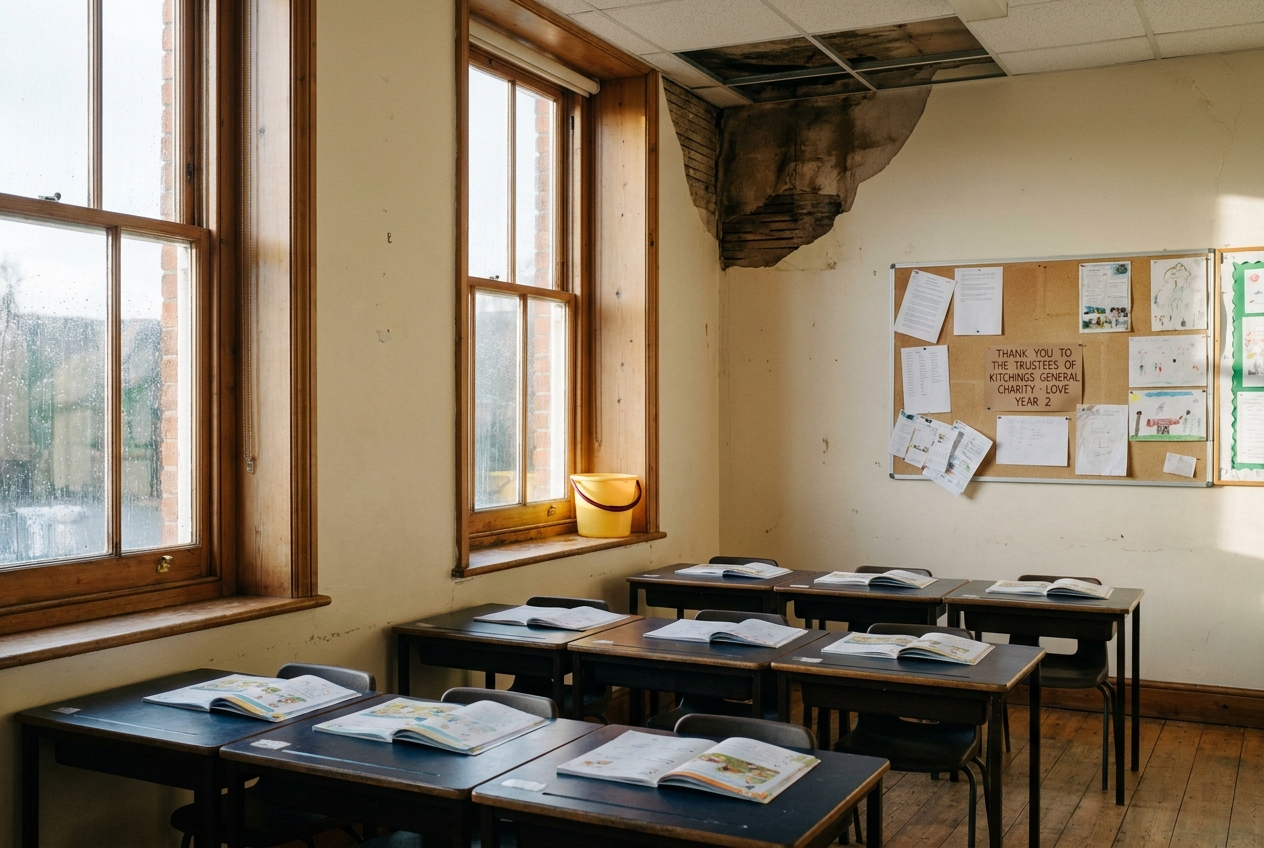
The back classroom at Bardney CE Primary is a 1958 single-storey extension on the rear of a Victorian schoolhouse. It is the room where the Year Twos do their reading, where the Christmas-card production line was running until just before the holidays, and where, on the morning of Tuesday 6 January, three of the ceiling tiles came down in the course of a single hour. The cause was the long period of rain that fell across Lincolnshire between the second and fifth of January, and a flashing detail on the rear roof which, the building surveyor told us, had been failing slowly for at least two winters.
Ruth Dawson, the head teacher, telephoned me at half past eleven that morning. The children had been moved into the hall and the room had been taped off. The school's first call had been to the local authority's school-buildings team in Lincoln, who confirmed that the school was in the queue for a full re-roof in the 2027-28 capital programme. Their advice, in the meantime, was to commission a temporary patch from a local roofer, with the cost to be reclaimed against a small school-buildings emergency budget that, depending on circumstance, might or might not be available before the end of the financial year.
The roofer that Ruth has used for the last decade, a small firm in Wragby, was on another job until Friday. The first weather window of any reliability was the Friday afternoon. The forecast for the following week was unbroken rain. The school could not run the back classroom while the ceiling was open. The school's own reserve for small repairs was £140. The roof patch quote was £620.
I rang Geoffrey, who rang Darren, who rang Christopher. The trustees agreed within an hour to make a Quiet Door grant of £480 to bridge the gap between the school's small reserve and the roofer's quote, on condition that the local authority's emergency budget was applied for in the usual way and any reimbursement was returned to the trust. The roofer was on the back roof of the schoolhouse by mid-morning on the Friday, the patch was finished by 14.30, and the room was back in use on the Monday following. The Year Twos missed three days of their normal classroom and one wet afternoon in the hall. The Christmas-card production line, mercifully, had already closed.
What this was, and what it wasn't.
It is worth being precise about what the trust did and did not do here. We did not pay to repair a primary-school roof. The structural roof is, properly, the responsibility of the local authority, and a full re-roof costing in the order of forty-five thousand pounds is on the 2027-28 capital programme. We paid for a temporary patch — the kind a small firm of roofers can do in an afternoon for a few hundred pounds — on the understanding that the proper repair would follow. The patch is good for, the roofer judged, between eighteen months and three winters.
The school will continue to operate the back classroom through the rest of this academic year and the next. A small bucket lives on the windowsill in case of unexpected drips. The Year Twos have written a thank-you card to the trustees, which is currently propped on the vestry mantelpiece. It is the kind of card a Year Two writes, and it is one of the better things to have arrived in the vestry post in some years.
A small lesson about scale.
The trustees discussed, at our February meeting, the question of whether the Kitchings General Charity should be in the business of school-building grants at all. Our scheme of management permits us to make grants for the advancement of education in Bardney and Bucknall, and a temporary roof patch on a classroom is plausibly within that purpose. But there is a slippery slope: a roof today, a window-frame tomorrow, an interactive whiteboard next term. We are not equipped to be the maintenance backstop for two primary schools.
The conclusion the trustees reached — and which has been quietly added to the grant-making policy for the schools fund — is that we will consider one-off bridging grants of up to £500 where (a) the local-authority budget exists but is not available within the necessary timeframe and (b) the school has no other ready source of the money. We will not become a regular contributor to building maintenance. We will not be making a grant in the order of the full re-roof. Our scale is the patch, not the repair. That is, on the whole, what a small parish trust is for.
A note on the figures.
The Quiet Door grant of £480 was paid to the school on Friday 9 January 2026. The local authority's emergency budget application is in train; the school's office expects to hear by the end of March. If the application is successful, the school will return the £480 to the trust, where it will be added back to the Quiet Door reserve. If not, the grant will stand as a Schools & Pupils Grant for the 2026 financial year and will be reported under that fund's heading in the annual report. Either way, the children have a dry classroom for the spring term, which was the point.
Ruth Dawson and the staff at Bardney CE Primary have been, throughout, a model of practical good cheer. The trustees are most grateful to them for their patience, and to the roofer in Wragby who fitted the job into a Friday afternoon. The Year Twos' thank-you card will go up in the vestry display board when the next quarterly letter is folded.
Filed under: schools & pupils, Quiet Door, the limits of small grants.
Update: the local authority budget application was acknowledged on 16 January 2026.